"THERE'S A PLACE CALLED OMAHA NEBRASKA," Groucho Marx sang once, before misplacing the town on the map: "In the foothills of Tennessee." Singers don't seem to know just where Omaha is, come to think of it. All the Counting Crows knew was that the town was "somewhere in Middle America," while Bob Seeger placed himself "on a long and lonely highway, east of Omaha," which could be just about anywhere that's not west of Omaha. Way to be specific, gents.
Well, we at the Bottle Gang have been to Omaha. And not just in a passing-through-on-the-way-to-somewhere-else sort of way. We've been to parties with The Faint and Conner Oberst (and a lesser-known act from Omaha, Mulberry Lane, who once sent us a postcard from Japan). We've crashed three of Alexander Payne's shindigs, once wishing him a happy birthday when it wasn't his birthday at all, and made many calls to the Academy Award-winning writer/director, several times by accident, which he did not appreciate. We drunkenly strolled through the halls of the Joslyn Museum with Omaha's former mayor, Hal Daub, after dining with Pulitzer Prize-winning playwright Edward Albee, who has a yearly theater festival in Omaha. We made friends with an enormous, bearded astrologer and blues guitarist who is reported to have once bitten off a man's ear. Also, we've been to a lot of Omaha strip clubs, although, on the whole, we prefer those in Council Bluffs.
So trust us when we say that Omaha is a great place to drink. We've drunk our share there. The alcohol is plentiful and it's cheap -- three cocktails made with middle-shelf liquor will cost you the same as one cocktail in Minneapolis's North Loop. But be warned: Omaha bars generally are not very well stocked when it come to liquors, generally carrying a small and generic selection, and Omaha bartenders, for the most part, are only capable of making a half-dozen of the most common drinks, and will look confused if you ask for anything fancy. What Omaha lacks in cocktail sophistication, however, it makes up for in character. Sometimes the city seems like a glacier flowed over it in 1964 and just recently melted, leaving the architecture of the period perfectly preserved, and so here we have a town filled with oversized Steak Houses and gaudy signage, an eye-popping, kitschy delight.
Drinkers, should you find yourself in Omaha, here is a travelogue of our favorite watering holes.
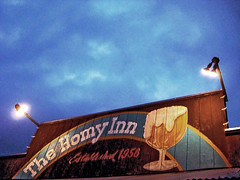 We begin, as we always do, on Saddle Creek at the Homey Inn. This small neighborhood bar has gotten quite busy recently, since Esquire named it one of the best bars in America; it used to be quite desolate, except on weekends, when all Omaha bars spring to life.
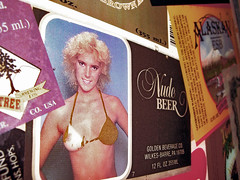
The Homey Inn seems constructed out of the fallen remains of previous bars, some in Omaha, some elsewhere in the Midwest. The walls are hung with fading newspapers and decorated with ancient menus, beer cans from long forgotten brands, and old novelty items from liquor distributors, such as Nude Beer, upon which photos of women in Eighties hairstyles wear brassieres that can be scratched off to reveal ample bosoms. Some have been scratched.
 They also have champagne on tap, both sweet and dry. Of course, it's not real champagne, but rather a fruity and inexpensive sparkling wine, but who cares, really? They don't know how to make a champagne cocktail with the stuff, but they will gamely try, tossing in a few drops of bitters and a packet of sugar. You wouldn't serve it to Humphrey Bogart, but it's passable.
Additionally, the Homey Inn serves peanuts. In dog bowls. And you can order food from across the street, from a Beatles-themed pasta restaurant called Sgt. Peffers, presumably out off fear that if they called themselves Sgt. Peppers, Apple Records would sue. Interestingly, the Homey Inn has a wider selection of Irish beers than many Eire-styled pubs. We couldn't tell you why this is. And we don't care to ask. We're happy enough sipping our sweet sparkling wine, eating our peanuts, waiting for the delivery man to bring us a plate of spaghetti, and scratching the bra off a woman on an old beer label.
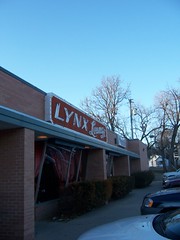 Next, it's onward to The Lynx Lounge, just a few blocks away on NW Radial Hwy. The bar is rather unassuming to look at from the outside, nestled in a strip mall between an assortment of low-rent businesses that have, in the past, included an off-brand makeup store and an erotic lingerie dealer. Inside, however, the bar is pure Seventies, including a fire pit and a recessed and mirrored alcove where couples can pair off for a more intimate drinking experience. The bar is kept dark, and the alcove may be the darkest spot on earth -- it is pitch black until a bartender lights a candle, and then the only thing visible in the alcove is the candle.
The bar is mostly patronized by African-American drinkers, who have, in the past, been so surprised to see the Bottle Gang sidle up to the bar that they have greeted us warmly and bought us drinks. Omaha is a disquietingly segregated town, with most of its black community living north of the city, and white Omahans can be unaccountably nervous around their black neighbors. Actually, this isn't just true of white Omahans -- we once brought a young girl of Korean extraction to the Lynx Lounge, and, upon leaving, she asked a surprising question: "Did you notice that we were the only white people in the bar?" We briefly considered reminding her that, as an Asian, she wasn't precisely white, but then we decided the whole discussion was crass and politely let it drop.
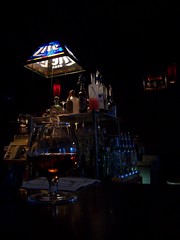 Anyway, we've been patronizing the Lynx Lounge for years, for their good selection of brandies, their swanky ambiance, and their terrific jukebox upon which you can find a marvelous selection of soul and R&B songs. We may be too light-skinned to pretend to be Billy Dee Williams, but that doesn't mean we won't drink at a place where he would seem perfectly at home. (SPARBER)
Read part two here.





 A SPECIAL BOTTLE GANG ABROAD REPORT FROM CHICAGO
 THINK WE'VE COVERED ALL THERE is to cover about the martini? Think again. Aside from the time we spend making crazy cocktails from books, we also spend some time messing around trying to make new drinks. Most of the time it ends in disaster, a small amount of the time in success and this one time? Well, the less said about that the better. Let's just say the monkey's doing much better now. We should probably take a tip from Charles Dana Gibson and keep it simple, sippers.
 Matches, napkins, and other everyday objects are generally discarded without a second thought. At The Bottle Gang, we see greater possibilities in these overlooked objects — we see their potential to do the seemingly impossible, which gives them an edge of store-bought magic tricks. Such pre-fab examples of sleight-of-hand encourage immediate suspicion. Upon seeing a magician link and unlink three metal rings, audiences immediately start suspecting trickery. For this reason, we find the bar trick infinitely more impressive. It seems, for a moment, that something impossible has happened. Magic has been produced with everyday objects — plucked not from a hidden jacket pocket, but right from the bar where anyone could have found them.

 Conrad's book -- which reads like a martini encyclopedia -- includes an excerpt from My Last Sigh by filmmaker Luis Buňuel, who explicitly links the drink to religion: "Like all cocktails, the martini, composed essentially of gin and a few drops of Noilly Prat, seems to have been an American invention. Connoisseurs who like their martinis very dry suggest simply allowing a ray of sunlight to shine through a bottle of Noilly Prat before it hits the bottle of gin. At certain periods in America it was said that the making of a dry martini should resemble the Immaculate Conception, for, as Saint Thomas Aquinas once noted, the generative power of the Holy Ghost pierced the Virgin's hymen 'like a ray of sunlight through a window -- leaving it unbroken.'"
 We can thank a country singer named Slim Dusty for some of this sense of Australia’s wildness. Dusty, born David Gordon Kirkpatrick in New South Wales in 1927, was the first Australian performer to enjoy success on the American pop charts — with a drinking song, no less! In 1957, Dusty released a song titled “The Pub With No Beer” as the b-side to a song titled “Saddle Boy.” But it was “Pub With No Beer” that caught on, because the first Australian song to chart in American and earning Dusty the first Gold Record issued to an Australian.
 WE CONSIDER OURSELVES a pretty top shelf website, but sometimes, you can't drink top shelf. Maybe you're at a bar that just doesn't have the good stuff. Maybe someone else is buying. Or maybe you're in a band. See, most venues will give you drink tickets when you play, which are good for everything-- as long as it's on tap or below waist level.
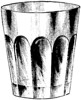 2 oz. whiskey