Round 1
1. Who was the first woman to serve as a justice on the Supreme Court? Sandra Day O'Connor
2. What year of the Olympics were filmed in Nazi filmmaker Leni Riefenstahl's film Olympia Spiele? 1936
3. What is the first and last name of the character from that 70's show cast who is referred to as a "cocktail dad"? Red Forman
4. What is the highest waterfall on the Mississippi river? St. Anthony Falls
5. The rules of the very difficult and useless game golf is written jointly by two organizations, one in the U.S. and one in what country? Scotland
6. What rapper acted as the Mouse King in the Nutcracker at Baltimore's School for the Arts? 2pac
7. What Canadian-born architect, who designed a building in Minneapolis, also designed the trophy for the World Cup of Hockey? Frank Gehry
8. What month did Kurt Cobain die in in 1994? April
9. In 31 B.C. The Final War of the Roman Republic ended in the battle at Actium. Who won? Octavian, or Caesar
10. Billy Madison rises himself out of his hung-over pool side stupor at the beginning of the film Billy Madison when he realizes what special day it is. What day is it? Nudey Magazine Day
11. What city and state did Michael Moore grow up in? Flint, Michigan
12. What is the name of the first published novel by Chuck Palahniuk? Fight Club
13. What country is Lesotho entirely surrounded by? South Africa
14. What rite of passage, when directly translated is known as: one to whom the commandments apply? bar or bat mitzvah
15. Author Madeleine L'Engle died on Friday. What was her most popular book? A Wrinkle in Time
Round 2
1. What is Peter Griffin's sole response to all questions when he is on a parody of Jeopardy on the "Brian: Portrait of a Dog" episode? Diarrhea
2. What major Southern city was occupied by the Union early in the Civil War and was thus spared the destruction that many Southern cities endured during the Civil War? New Orleans (wikipedia.org)
3. In what city did Jimi Hendrix die? London, England (wiki)
4. Name the four inner planets? Mercury, Venus, Earth, Mars
5. What is the most populuous city in Vietnam? Ho Chi Minh City
6. What are the names of the crash test dummies who are the mascots for the National Highway Traffic Safety Administration? Vince and Larry
7. Who was the lead role in the TV show Monk originally written for? Michael Richards
8. What movie did Kevin Spacey win his first Oscar for? The Usual Suspects
9. Hmong people's original homeland is the mountainous Southern region of what country? China
10. The U.N. recognizes 192 countries, but most scholars agree there are 194 countries in the world. One country missing is an island, and the other one is completely within the borders of another country, name both. Taiwan, Vatican City
11. What non-coastal Western state has the lowest median age in the United States with a median age of 28.5? Utah
12. Which county has a higher Asian population, Hennepin or Ramsey county? Ramsey
13. In rap slang, if someone is a crooked eye sipper what does that mean? they drink st. ives malt liquor
14. What living singer, born in 1940, is the only vocalist to win Grammy's in three separate categories, jazz, pop and R&B? Al Jarreau
15. What title, used in numerous fields, literally means "holding a place"? lieutenant
Music Round
Daughter – Pearl Jam
The Rat – The Walkmen
The Beatles – Being for the Benefit of Mr. Kite
50 Cent – 21 Questions
Death Cab for Cutie – Soul Meets Body


9.04.2007
Chuck & Sean's Trivia: The answers for 09.02.07
EVERY SUNDAY NIGHT down at the 331 Club in Northeast Minneapolis, writer Chuck Terhark and musician Sean McPherson throwdown on some kickass trivia, and The Bottle Gang is proud to sponsor it. Starting this week, we'll be posting the questions and answers from last week's trivia for ONE WEEK ONLY, so study up and learn from your mistakes.
Round 1
1. Recently a baseball game between the Detroit Tigers and the New York Yankees resulted in a score of 0 to 16. Which team got 16? Detroit Tigers
2. What Seinfeld character said “you could throw a dart and find someone better than me” and also described himself as “steeped in gayness” in the same episode? George Castanza
3. Please name all seven counties in the Twin Cities seven county metro area? Anoka, Carver, Dakota, Hennepin, Ramsey, Scott, Washington
4. What are the O’s made of on the logo for the TV show Divorce Court? Wedding rings
5. What college was the crap show Felicity based on? New York University
6. Alberto Gonzales is a dipshit. Spell the dipshit’s last name? Gonzales
7. What state pays the most for redeeming used cans? Michigan, 10 cents
8. What state is Arlen Specter a senator from? Pennsylvania
9. What date and day of the week did the 35W bridge fall down on? Wednesday August 1, 2007
10. Mississippi is the fattest and poorest state in the United States. What pseudo Midwestern state is the slimmest state, with only 18% of the adult population being overweight? Colorado
11. Rupert Murdoch’s company bought the Wall Street Journal two weeks ago. What is the official name of the company that bought it? News Corp.
12. How many weeks does Billy Madison get to pass the tests for each grade in the amazing film, Billy Madison? 2 weeks
13. Who founded the Order of the Missionaries of Charity? Mother Teresa
14. Hurricane Felix is moving through the Carribean right now as we speak. What number Atlantic hurricane is Felix for this year? 6
15. Who is the first African-American Secretary of State? Colin Powell
Round 2
1. Was Saddam Hussein Sunni or Shia? Sunni
2. What was the 50th state to be joined into the Union? Hawaii
3. What year did Nixon unsuccessfully run for President? 1960
4. What is the capital of Egypt? Cairo
5. What was Bill Murray's character’s name in the Royal Tenenbaum's? Raleigh St. Clair
6. What is the name of the new head coach of the Gophers football team? Tim Brewster
7. What was Theodore Roosevelt doing in Minnesota when he first said “speak softly and carry a big stick” on September 2, 1901? Attending the Minnesota State Fair
8. Name one of the two closest bus routes that flank the 3-3-1 club. #17 & #11
9. Are the days on Mars longer or shorter than those on Earth? Longer, 24 hours 39 minutes
10. What is the total complement of genes in an organism or cell known as? Genome
11. Which gender is known as the homogametic sex in chromosomal studies? Women XX
12. What 2005 movie had the tagline, "the cure for the common man"? Hitch
13. Who is known as the father of geometry? Euclid
14. What type of Jewish bread is often used to make French toast in New York Diners? Challah
15. In 490 B.C. Pheidipides ran 26 miles, starting in Marathon to announce the Greeks success over the invading Persian. What city was he running to? Athens
Round 1
1. Recently a baseball game between the Detroit Tigers and the New York Yankees resulted in a score of 0 to 16. Which team got 16? Detroit Tigers
2. What Seinfeld character said “you could throw a dart and find someone better than me” and also described himself as “steeped in gayness” in the same episode? George Castanza
3. Please name all seven counties in the Twin Cities seven county metro area? Anoka, Carver, Dakota, Hennepin, Ramsey, Scott, Washington
4. What are the O’s made of on the logo for the TV show Divorce Court? Wedding rings
5. What college was the crap show Felicity based on? New York University
6. Alberto Gonzales is a dipshit. Spell the dipshit’s last name? Gonzales
7. What state pays the most for redeeming used cans? Michigan, 10 cents
8. What state is Arlen Specter a senator from? Pennsylvania
9. What date and day of the week did the 35W bridge fall down on? Wednesday August 1, 2007
10. Mississippi is the fattest and poorest state in the United States. What pseudo Midwestern state is the slimmest state, with only 18% of the adult population being overweight? Colorado
11. Rupert Murdoch’s company bought the Wall Street Journal two weeks ago. What is the official name of the company that bought it? News Corp.
12. How many weeks does Billy Madison get to pass the tests for each grade in the amazing film, Billy Madison? 2 weeks
13. Who founded the Order of the Missionaries of Charity? Mother Teresa
14. Hurricane Felix is moving through the Carribean right now as we speak. What number Atlantic hurricane is Felix for this year? 6
15. Who is the first African-American Secretary of State? Colin Powell
Round 2
1. Was Saddam Hussein Sunni or Shia? Sunni
2. What was the 50th state to be joined into the Union? Hawaii
3. What year did Nixon unsuccessfully run for President? 1960
4. What is the capital of Egypt? Cairo
5. What was Bill Murray's character’s name in the Royal Tenenbaum's? Raleigh St. Clair
6. What is the name of the new head coach of the Gophers football team? Tim Brewster
7. What was Theodore Roosevelt doing in Minnesota when he first said “speak softly and carry a big stick” on September 2, 1901? Attending the Minnesota State Fair
8. Name one of the two closest bus routes that flank the 3-3-1 club. #17 & #11
9. Are the days on Mars longer or shorter than those on Earth? Longer, 24 hours 39 minutes
10. What is the total complement of genes in an organism or cell known as? Genome
11. Which gender is known as the homogametic sex in chromosomal studies? Women XX
12. What 2005 movie had the tagline, "the cure for the common man"? Hitch
13. Who is known as the father of geometry? Euclid
14. What type of Jewish bread is often used to make French toast in New York Diners? Challah
15. In 490 B.C. Pheidipides ran 26 miles, starting in Marathon to announce the Greeks success over the invading Persian. What city was he running to? Athens
8.11.2007
A quick note about the Martini
I HAD HEARD THAT bartenders can be skittish on the subject of vermouth, but, in the last few months, I have discovered a rather startling phenomenon. On two separate occasions, in two separate bars, I had bartenders serve a gin Martini without any vermouth in it at all, and act surprised when I complained. The Martini has only two necessary ingredients (three if you use orange bitters, but few bars carry them); if you leave out the vermouth, you're serving a straight shot of gin. One bartender had to be cajoled into putting the Vermouth in, and then added it in drops, like he was dropping acid into a base and was afraid the whole thing might explode at any second.
"Customers don't like vermouth," he explained. Well, then, they don't like the Martini, and should be steered to another drink. I'm frankly flabbergasted by this. What self-respecting bartender takes a drink order, and then deliberately leaves out the defining ingredient, without even bothering to ask the customer if that's what they want? Here's a hint to area barkeeps: If a customer orders a gin Martini, and even goes so far to specify what gin they want in it, chances are they want a Martini, and not a glass of gin with an olive in it.
You know what else people don't like? Bitters and rye whiskey, so I must assume that when someone orders a Manhattan from these bartenders, they get served a maraschino cherry, and nothing else. (SPARBER)
"Customers don't like vermouth," he explained. Well, then, they don't like the Martini, and should be steered to another drink. I'm frankly flabbergasted by this. What self-respecting bartender takes a drink order, and then deliberately leaves out the defining ingredient, without even bothering to ask the customer if that's what they want? Here's a hint to area barkeeps: If a customer orders a gin Martini, and even goes so far to specify what gin they want in it, chances are they want a Martini, and not a glass of gin with an olive in it.
You know what else people don't like? Bitters and rye whiskey, so I must assume that when someone orders a Manhattan from these bartenders, they get served a maraschino cherry, and nothing else. (SPARBER)
7.26.2007
The Flaming Moe :: A Simpsons Movie Special
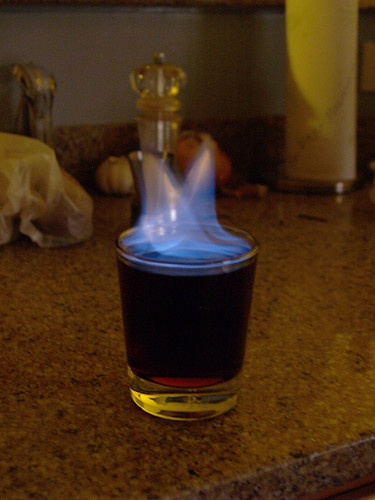 SO YOU ALL KNOW about the Flaming Moe, right? Episode 8F08 in the third season revolved around it—the drink Homer invented and then Moe ripped off whose secret ingredient is children's cough syrup and that's made special by lighting it on fire.
In the show, Homer explains that the drink was invented when one of Marge's sisters drank the last beer. He combined all the alcohol that was left in all the bottles in the house, accidentally including children's cough syrup, and when Patty (or perhaps Selma) ashed into his drink, it went up in flames, improving its taste immeasurably. Most bars (I'm pretty sure) don't have children's cough syrup, so we set about making up a drink that would approximate the Flaming Moe. The only kinds of alcohol you can actually see when he's making the drink are tequila and creme de menthe, but man, we're not going to combine those two drinks. It has to have enough mass to fill a largish glass (hello, vodka) and taste like cough syrup (enter the flavored brandies) and be flammable (welcome, 151 rum).
3 oz. vodka
1.5 oz. Kirschwasser
1.5 oz. Creme de Cassis
1.5 oz. Blackberry Brandy
1 tsp. 151 rum
Take everything except the rum and pour it into a rocks glass. Stir. Now take a spoon, turn it upside down, and pour the 151 rum over the spoon so it distributes itself evenly over the top. WARNING: DO NOT ACTUALLY DO THIS. THE BOTTLE GANG ACCEPTS NO RESPONSIBILITY FOR ANY DAMAGES INCURRED BY THIS DRINK. Light it.
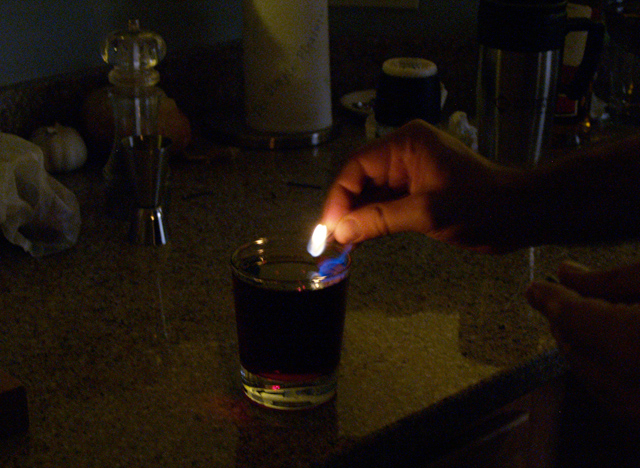
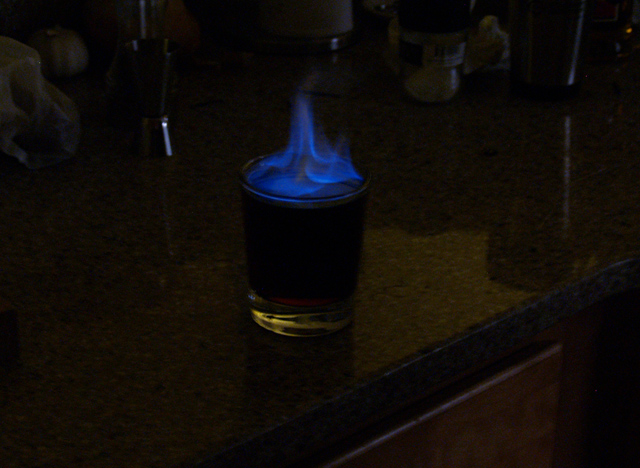
But I wouldn't drink it if I were you. I'd make it a shot if you had to, but in the show, it's clearly in a bigger glass than a shot glass, so we made it in a rocks glass. If it's a shot, I'd probably nix the vodka and cut the other things down to .5 oz. apiece. Again, though, DON'T EVEN TRY TO MAKE THIS. JUST LOOK AT THE PRETTY PICTURES. (McPHERSON)
7.25.2007
Cocktailphernalia: Hobo pump decanter
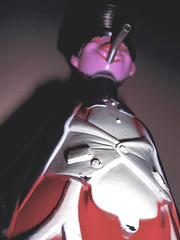
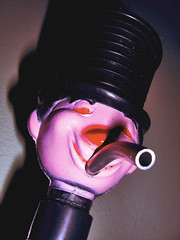
THIS PLASTIC NOVELTY, probably dating back to the early Fifties, is precisely what you want when you need to decant some liquor -- the sense that an inebriated, clowlike-hobo is vomiting liquor directly into your glass. (SPARBER)
7.20.2007
Book Review: The Ultimate Bar Book
 WHEN IT COMES TO getting a book with an exhaustive list of cocktail recipes for you to try out at home, you've got a lot of options, and they're all more or less the same. But if you want to get a book which will give you all that, but also enrich your knowledge of the art of cocktails and give it to you with a wink and a nod, you absolutely need to get Mittie Hellmich's Ultimate Bar Book.
The first thing that distinguishes it from most other bar books is that the cocktail recipes are divided into categories based on the dominant alcohol in the drink, not alphabetically. This makes it phenomenally easy, once you've familiarized yourself with the basic liquors, to find a drink to suit your mood. Feeling whiskey? Just flip towards the back and find something delectable to mix up. Within each section, there are also subsections devoted to particularly significant drinks and their variations. So you get a page discussing the history of the gimlet under gin, a spread on the Bloody Mary under vodka, and a whopping three pages each devoted to the Manhattan and the mint julep under whiskey.
That's the technical part of the book, but there's so much more. The front section includes a glossary of bar equipment (with illustrations of the implements), a glassware guide, a guide to types of drinks (with the histories of standards like the rickey, the fizz, the flip, and exactly makes a drink a highball), and an invaluable section on the science/art of making a drink. Did you know that most cocktails consist of three parts? Hopefully you do if you've been reading The Bottle Gang, but thinking of a cocktail as consisting of the base (the bedrock liquor, greatest by volume), the body (the modifier, a sort of comment on the main alcohol, like vermouth), and the perfume (the last touch that adds complexity to the drink, whether through sweetness, bitterness, or perhaps a fruity overtone) makes it much easier to come up with good cocktails on your own.
Then there's Hellmich's writing, which is dry as a dry martini, especially in the sections that detail the stories of each type of alcohol. "Although originally used as a health tonic," Hellmich writes, "gin has no official medicinal value today; nonetheless, Martini drinkers claim a variety of positive effects."
And regarding vodka: "Even the regular premium vodkas tend to have a somewhat harsh finish, so unless you wish to evoke a Dostoevskyian moment, they are really suitable only as mixers."
There are lots of websites that can give you recipes for making cocktails, but Hellmich's Ultimate Bar Book treats the subject with respect and just a bit of tongue in cheek—a perfect companion for a night of tippling.(McPHERSON)
7.16.2007
Road Trips: 21 Club
The Bottle Gang tippled a glass or three
at New York's 21.
We didn't drink them dry,
though they may say we tried.
We left so we could drink no more,
to go home and dream from our beds
that when we come back to 21
they don't treat us like the Feds.
 WE'VE BEEN INTERESTED in New York's 21 Club for years, mostly because it piques our fondness for history. After reading Marylin Kaytor's "21" The Life and Times of New York's Favorite Club, we found that the club could have modeled itself after the wildly rambunctious, unbelievably booby-trapped speakeasies of Hollywood talkies. However, Kaytor's anecdotes are of the we-can't-make-this-stuff-up-folks kind, which helped us draw our own conclusion: Hollywood went to 21 for inspiration. Every nook and cranny in this low-light, checkered tablecloth atmosphere has its own fantastic story.
Our favorite stories about 21 begin during Prohibition with a man named Soll Roehner, a necessarily trustworthy construction worker, and his equally trustworthy, hand-picked crew. He was put in charge of designing a Federal Agent-proof door, not to keep the Feds out of 21 altogether (21 has never been a private club), just keep them from finding the 2,000 gallons of illegal hooch hidden in the basement. This door would have to endure, successfully, multiple tap tests, draft tests, and any other liquor-seeking tests the Feds could dream up. Roehner had quite a task at hand. He set to work with some ingenious ideas; not only did he design an invisible door, but an undetectable lock as well. Set a few feet back in a small alcove is a wall -- or the door to us insiders. Inside the alcove and on the back wall are thousands of small holes, many of them painted over now. To the Feds these looked like nothing other than places to put pegs on which to rest shelves -- and 21 did just that. They had cured hams hanging above miscellaneous sundries on the shelves. But one of these holes is actually a key hole. If inserted at just the right angle, an 18" long metal rod unlocks the behemoth, 5,000 pound door. Roehner had to design hinges that could facilitate this hulk to move smoothly, so as not to damage the brick on the door and the wall. In Kaytor's book, Roehner speaks about his famous feat of architecture:
"[The door] would have to function with precision balance to avoid damage to the brick door as it met the brick jam stop. A concealed metal adjustment stop was fabricated so that the brick just kissed against brick as the door swung shut. In the locked position, the door had to be perfectly solid with no visible play. The lock had to operate without a conventional key, to be absolutely jam-proof, and to be lockable from the warehouse side in case of siege."
 Inside is a cavern of wines, practically over stuffed with bottles as old as 1880. Bottles of wine seem to be stored in the cellar indefinitely, among them are wines owned by Elizabeth Taylor, Elvis, and Richard Nixon among hundreds of others. Each bottle has the name of its owner labeled on the bottom and facing outward for easy locating. Further back is yet another cavernous room. We had to practically fold ourselves in half to get through this literal hole in the wall. Inside is a luxurious dining room -- longer than it is wide with a table that almost matches the size of the room. This room is also the active red wine cellar, and bottles line the walls. It takes some tricky maneuvering getting out -- especially for those exiting after dining and imbibing. This doorway is jokingly referred to as The Sobriety Test.
It may only be out of sheer unwieldiness that all of this still resides at 21 -- the door in particular -- as many remnants from that dry time have been renovated out of the infamous brownstone at 21 West 52nd Street. "You have to understand," explains Philip W. Pratt, 21's Sommelier. "People did not like Prohibition -- it was not a happy time." So the coat closets with dummy walls that could only open with an electric charge from a strategically placed metal coat hanger are gone, as is the back bar shelf that could turn over and dump bottles of illegal alcohol down a chute leading directly to the New York City sewer system at the push of a button. Kaytor describes what this sight must have been like:
"Shades of Orson Welles, Vienna, and The Third Man -- if one had looked down the opening revealed behind the back bar as the shelves tipped over, one would have seen a brick-lined chute with iron spikes jutting from the walls, arranged so that bottles would strike the spikes and shatter, and then fall on down to an iron grating to smash completely any stubborn glass. Under the grating was an opening leading down past the basement drain and into the New York sewerage system, into which everything ran off to disappear forever!"
For those of you squealing over all of that lost liquor, according to Pratt, the speakeasy was only raided three times. Federal Agents spent many unsuccessful hours searching the place, undoubtedly growing more frustrated by the minute as the smell of alcohol filled the room, and seeing patrons holding only empty coffee mugs instead of splashing cocktail glasses. In one case, an agent thought he had them figured out. This agent asked to be lowered into the water tower on the rooftop, thinking that 21's stash of alcohol would be hidden there. Once he reached the water, however, he remembered that he didn't know how to swim and the search was called off. It was an unsuccessful search with a nearly successful drowning. Another raid was cut short by James J. Walker, New York's Mayor at the time. Of course, it would be devastating to his career to be caught drinking in a speakeasy so "he called his friend the police commissioner," explains Pratt, "and had all the Feds' cars towed." 21 still has Mr. Walker's private booth where he could "do whatever he wanted to do out of the public eye."
The 21 Club's sense of playfulness is not overshadowed by their extreme professionalism. There are lawn jockeys lining the facade of the building and toys hanging from the dining room ceiling -- the toys are an especially surprising sight for such a posh establishment. "This was the second plane that we hung up," Mr. Pratt says as he points upward to a large model plane of the Spruce Goose. "Mr. Hughes had to one-up the first plane we hung up." The first plane, according to Kaytor's book, was an American Airlines plane; 21's website says it was a British Airways "flying boat." Now there are thousands of different memorabilia hanging from the ceiling, from airplanes to baseball bats, brought in by patrons from around the world.
 As for 21s drink selection, they have a talent for making room for new tastes while making sure to keep the classics. We're sure this theory permeates throughout the entire establishment, in fact, and is one of the major reasons for its longevity. We tried The South Side, which is basically a mojito made with vodka instead of rum and, according to Pratt, was invented at 21 along with Humphrey Bogart's drink of choice, the Brandy and Benedictine. We also tried a Cosmopolitan, which, from the first sip, spoiled us rotten for any other Cosmos from any other bar. This Cosmopolitan made all the others we've had in the past seem like something poured out of a juice box rather than the fresh citrus concoction that was set before us at 21. And we couldn't pass up the opportunity to have a martini -- Tanqueray, dry Cezano vermouth, with a dash of orange bitters (yes! They have orange bitters!), straight up with a twist. It was perfect. We tried two of their newer additions to the drink menu, the Peg Leg and the Global Daquiri, which are lemon drinks. We weren't crazy about these new additions to the drink menu, which seemed to be sweet and sour takes on the same recipe, but, admittedly, they were tolerable.
21 isn't the only remaining speakeasy in New York City; Minetta's, Pete's Tavern, and Chumley's are just a few of the better known establishments that have remained open. 21, however, certainly has the heir of being the most notorious among the group.
We were curious if any of those Federal Agents returned to 21 after Repeal, if only to ask where the good stuff was hidden. Mr. Pratt could only conclude "they probably did." As of now, the Bottle Gang hasn't found any accounts of curious Feds returning to 21 on a friendlier basis. But we agree with Mr. Pratt that at least one agent must have come back. After all, curiosity almost drowned one of them. With a cocktail lounge as luxurious as 21's, we can't see any reason for staying away. Except the danger of drowning in libations more exciting than that found in a water tower.
(MAULT)
at New York's 21.
We didn't drink them dry,
though they may say we tried.
We left so we could drink no more,
to go home and dream from our beds
that when we come back to 21
they don't treat us like the Feds.
 WE'VE BEEN INTERESTED in New York's 21 Club for years, mostly because it piques our fondness for history. After reading Marylin Kaytor's "21" The Life and Times of New York's Favorite Club, we found that the club could have modeled itself after the wildly rambunctious, unbelievably booby-trapped speakeasies of Hollywood talkies. However, Kaytor's anecdotes are of the we-can't-make-this-stuff-up-folks kind, which helped us draw our own conclusion: Hollywood went to 21 for inspiration. Every nook and cranny in this low-light, checkered tablecloth atmosphere has its own fantastic story.
Our favorite stories about 21 begin during Prohibition with a man named Soll Roehner, a necessarily trustworthy construction worker, and his equally trustworthy, hand-picked crew. He was put in charge of designing a Federal Agent-proof door, not to keep the Feds out of 21 altogether (21 has never been a private club), just keep them from finding the 2,000 gallons of illegal hooch hidden in the basement. This door would have to endure, successfully, multiple tap tests, draft tests, and any other liquor-seeking tests the Feds could dream up. Roehner had quite a task at hand. He set to work with some ingenious ideas; not only did he design an invisible door, but an undetectable lock as well. Set a few feet back in a small alcove is a wall -- or the door to us insiders. Inside the alcove and on the back wall are thousands of small holes, many of them painted over now. To the Feds these looked like nothing other than places to put pegs on which to rest shelves -- and 21 did just that. They had cured hams hanging above miscellaneous sundries on the shelves. But one of these holes is actually a key hole. If inserted at just the right angle, an 18" long metal rod unlocks the behemoth, 5,000 pound door. Roehner had to design hinges that could facilitate this hulk to move smoothly, so as not to damage the brick on the door and the wall. In Kaytor's book, Roehner speaks about his famous feat of architecture:
"[The door] would have to function with precision balance to avoid damage to the brick door as it met the brick jam stop. A concealed metal adjustment stop was fabricated so that the brick just kissed against brick as the door swung shut. In the locked position, the door had to be perfectly solid with no visible play. The lock had to operate without a conventional key, to be absolutely jam-proof, and to be lockable from the warehouse side in case of siege."
 Inside is a cavern of wines, practically over stuffed with bottles as old as 1880. Bottles of wine seem to be stored in the cellar indefinitely, among them are wines owned by Elizabeth Taylor, Elvis, and Richard Nixon among hundreds of others. Each bottle has the name of its owner labeled on the bottom and facing outward for easy locating. Further back is yet another cavernous room. We had to practically fold ourselves in half to get through this literal hole in the wall. Inside is a luxurious dining room -- longer than it is wide with a table that almost matches the size of the room. This room is also the active red wine cellar, and bottles line the walls. It takes some tricky maneuvering getting out -- especially for those exiting after dining and imbibing. This doorway is jokingly referred to as The Sobriety Test.
It may only be out of sheer unwieldiness that all of this still resides at 21 -- the door in particular -- as many remnants from that dry time have been renovated out of the infamous brownstone at 21 West 52nd Street. "You have to understand," explains Philip W. Pratt, 21's Sommelier. "People did not like Prohibition -- it was not a happy time." So the coat closets with dummy walls that could only open with an electric charge from a strategically placed metal coat hanger are gone, as is the back bar shelf that could turn over and dump bottles of illegal alcohol down a chute leading directly to the New York City sewer system at the push of a button. Kaytor describes what this sight must have been like:
"Shades of Orson Welles, Vienna, and The Third Man -- if one had looked down the opening revealed behind the back bar as the shelves tipped over, one would have seen a brick-lined chute with iron spikes jutting from the walls, arranged so that bottles would strike the spikes and shatter, and then fall on down to an iron grating to smash completely any stubborn glass. Under the grating was an opening leading down past the basement drain and into the New York sewerage system, into which everything ran off to disappear forever!"
For those of you squealing over all of that lost liquor, according to Pratt, the speakeasy was only raided three times. Federal Agents spent many unsuccessful hours searching the place, undoubtedly growing more frustrated by the minute as the smell of alcohol filled the room, and seeing patrons holding only empty coffee mugs instead of splashing cocktail glasses. In one case, an agent thought he had them figured out. This agent asked to be lowered into the water tower on the rooftop, thinking that 21's stash of alcohol would be hidden there. Once he reached the water, however, he remembered that he didn't know how to swim and the search was called off. It was an unsuccessful search with a nearly successful drowning. Another raid was cut short by James J. Walker, New York's Mayor at the time. Of course, it would be devastating to his career to be caught drinking in a speakeasy so "he called his friend the police commissioner," explains Pratt, "and had all the Feds' cars towed." 21 still has Mr. Walker's private booth where he could "do whatever he wanted to do out of the public eye."
The 21 Club's sense of playfulness is not overshadowed by their extreme professionalism. There are lawn jockeys lining the facade of the building and toys hanging from the dining room ceiling -- the toys are an especially surprising sight for such a posh establishment. "This was the second plane that we hung up," Mr. Pratt says as he points upward to a large model plane of the Spruce Goose. "Mr. Hughes had to one-up the first plane we hung up." The first plane, according to Kaytor's book, was an American Airlines plane; 21's website says it was a British Airways "flying boat." Now there are thousands of different memorabilia hanging from the ceiling, from airplanes to baseball bats, brought in by patrons from around the world.
 As for 21s drink selection, they have a talent for making room for new tastes while making sure to keep the classics. We're sure this theory permeates throughout the entire establishment, in fact, and is one of the major reasons for its longevity. We tried The South Side, which is basically a mojito made with vodka instead of rum and, according to Pratt, was invented at 21 along with Humphrey Bogart's drink of choice, the Brandy and Benedictine. We also tried a Cosmopolitan, which, from the first sip, spoiled us rotten for any other Cosmos from any other bar. This Cosmopolitan made all the others we've had in the past seem like something poured out of a juice box rather than the fresh citrus concoction that was set before us at 21. And we couldn't pass up the opportunity to have a martini -- Tanqueray, dry Cezano vermouth, with a dash of orange bitters (yes! They have orange bitters!), straight up with a twist. It was perfect. We tried two of their newer additions to the drink menu, the Peg Leg and the Global Daquiri, which are lemon drinks. We weren't crazy about these new additions to the drink menu, which seemed to be sweet and sour takes on the same recipe, but, admittedly, they were tolerable.
21 isn't the only remaining speakeasy in New York City; Minetta's, Pete's Tavern, and Chumley's are just a few of the better known establishments that have remained open. 21, however, certainly has the heir of being the most notorious among the group.
We were curious if any of those Federal Agents returned to 21 after Repeal, if only to ask where the good stuff was hidden. Mr. Pratt could only conclude "they probably did." As of now, the Bottle Gang hasn't found any accounts of curious Feds returning to 21 on a friendlier basis. But we agree with Mr. Pratt that at least one agent must have come back. After all, curiosity almost drowned one of them. With a cocktail lounge as luxurious as 21's, we can't see any reason for staying away. Except the danger of drowning in libations more exciting than that found in a water tower.
(MAULT)
Subscribe to:
Posts (Atom)
 2 oz. whiskey